
We engineer the operational layer that makes AI actually work.
AI at scale isn't one problem—it's five, and they have to be solved together. Strategy without infrastructure is a slideshow. Infrastructure without operating models is shelfware. We work across every layer—from boardroom to production—engineering the foundations that turn pilots into working systems.

The Activation Layer
Most enterprises have a clear vision for AI. What they lack is the connective tissue—the data architecture, AI infrastructure, and operating models—that makes intelligent systems actually run.
Alture Studio is an engineering practice built to close that gap. We work hands-on with your teams to refactor the operational core, so your AI investments finally deliver what they promised.

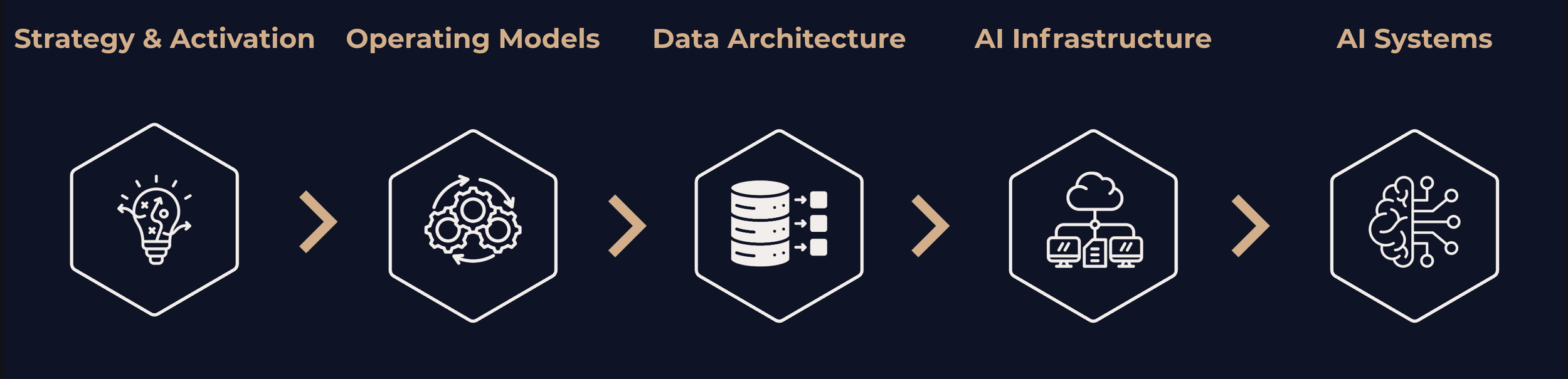
The Five Pillars
Five disciplines. One integrated approach.
Our diagnostic and delivery framework. Every engagement—whether a diagnostic or a full build—maps deliverables to these pillars. They represent the operational infrastructure required to move AI from strategy to production.
-
What it is: The foundation that ensures every technical build solves a real business problem—and that the organization is prepared to govern AI responsibly as it scales.
Why it matters: Without strategic alignment, AI initiatives become science projects. Without governance, they become liabilities. This pillar ensures you're building the right things, in the right order, with the right guardrails.
What we do:
Define your AI adoption approach
Identify business pain points and operational bottlenecks
Map AI capabilities to business needs
Define, analyze, and prioritize AI use cases
Classify each use case by disposition—what to automate, what to augment, and what not to touch
Evaluate build vs. buy decisions—custom, off-the-shelf, partner, or hybrid
Prototype high-value initiatives before committing to full build
Establish an AI Governance Framework—decision rights, risk tolerance, ethical guardrails, compliance requirements
Define Value Realization Framework—baseline metrics, success criteria, and measurement approach so you can prove AI is delivering
Create a phased roadmap for iteration and scale
What you walk away with:
AI Adoption Strategy
Prioritized Use Case Portfolio with Disposition Map (automate / augment / leave alone)
Business Case for top initiatives
Build vs. Buy Analysis
AI Governance Framework
Value Realization Framework—baseline metrics, success criteria, leading indicators
Activation Roadmap with sequencing and dependencies
-
What it is: The redesign of how your organization works—so teams can actually absorb, trust, and act on the intelligence AI systems generate.
Why it matters: Most AI initiatives fail not because the technology doesn't work, but because the organization isn't structured to use it. Legacy workflows, unclear roles, and resistance to change kill adoption. We lead with change management—not as a checkbox, but as the foundation for everything in this pillar. If the people side isn't addressed first, nothing else sticks.
What we do:
Lead with change management—assess organizational readiness, identify resistance, and build the adoption strategy before redesigning workflows
Map current-state processes and value streams
Simplify workflows before introducing automation (rationalization before automation)
Co-design future-state operating models with the teams who'll operate them—not in isolation
Define team topologies for when humans collaborate with agents
Clarify roles and decision rights—including human-AI collaboration boundaries
Assess capability gaps and build enablement plans
Develop change management execution roadmap
What you walk away with:
Current-State Process Assessment
Future-State Operating Model (co-designed with operational teams)
Team Topology Design
Role Definitions & RACI (including human-in-the-loop touchpoints)
Capability Enablement Roadmap
Change Management Plan
-
What it is: The foundation that makes data usable for intelligence—discoverable, trusted, governed, and structured for AI reasoning.
Why it matters: AI systems are only as good as the data they consume. Fragmented sources, poor quality, and missing context cause hallucinations, bad outputs, and failed pilots. And here's the strategic reality: your competitive advantage in AI isn't the model—it's your proprietary knowledge. This pillar builds the architecture to make that knowledge usable.
What we do:
Assess the current data landscape—sources, flows, quality, gaps
Design data governance—ownership, lineage, access controls, compliance
Architect for AI readiness—RAG pipelines, vector stores, knowledge graphs
Design knowledge ontologies—mapping domain relationships so AI systems can reason about your business, not just retrieve data
Build metadata and cataloging strategies for discoverability
Design integration and pipeline architecture
Establish data quality monitoring and remediation processes
Implement DataOps for continuous observability
What you walk away with:
Data Landscape Assessment & Quality Scorecard
Data Architecture Blueprint
Data Governance Framework
AI-Ready Data Design (RAG, vector, knowledge graph architecture)
Knowledge Ontology Design
Metadata & Cataloging Strategy
Data Quality Roadmap
DataOps Implementation Plan
-
What it is: The deployment and orchestration layer that makes AI systems production-ready. We build the runtime environments, integration plumbing, and operational controls that allow AI systems to execute reliably at enterprise scale—not generic cloud consulting, but the specific infrastructure AI needs to move from sandbox to production.
Why it matters: Productized LLM platforms solve the model problem, not the integration problem. The moment you move beyond a chatbot to agents that query databases, call APIs, and trigger workflows, you're deep in infrastructure territory. Most failed AI pilots work fine in a notebook. They fail when someone tries to make them production-grade. That's where this pillar lives.
What we do:
Design agent runtime environments—where your AI systems execute, how they're containerized, and how they scale
Build secure integration plumbing—connecting agents to enterprise systems, APIs, and data sources with proper authentication and access control
Define AI Identity Strategy—authentication, authorization, access scope, and audit trails for autonomous agents, treated with the same rigor as human identity management
Implement observability and cost management—monitoring what agents are doing, tracking inference costs, and maintaining audit trails for autonomous decisions
Architect for resilience—ensuring AI systems degrade gracefully, handle failures, and don't become single points of failure
Design modular, vendor-neutral foundations—avoiding lock-in while maintaining the flexibility to adopt new models and platforms as they emerge
What you walk away with:
Production-Ready Agent Infrastructure—containerized, scalable runtime environments for AI workloads
Enterprise Integration Layer—secure connections between agents and your existing systems
AI Identity Strategy—agent authentication, authorization, and access governance
Observability Stack—dashboards, logging, and alerting configured for AI system behaviors
Cost Management Framework—visibility into inference spend with controls to prevent runaway costs
Infrastructure Architecture Documentation—runbooks, diagrams, and operational guides your team can maintain
-
What it is: The engineering of AI agents that reliably execute complex workflows—reasoning, planning, using tools, and taking action within defined boundaries.
Why it matters: Most enterprise AI stops at chat. AI systems go further—they act. But without proper architecture, agents are unreliable, unpredictable, and unsafe. This pillar builds intelligence that actually operates.
What we do:
Design agent architecture—types, capabilities, boundaries, interaction patterns
Engineer orchestration—multi-agent coordination, workflow management, failure handling
Integrate tools and APIs—connect agents to enterprise systems for real action
Build prompt and context systems—memory, retrieval, and context management for consistent behavior
Implement guardrails—validation, human-in-the-loop checkpoints, safety controls
Create evaluation frameworks—testing, regression detection, quality assurance
Establish agent observability—logging, tracing, monitoring
Design continuous improvement loops—feedback mechanisms for ongoing refinement
What you walk away with:
Agent Architecture Design
Orchestration Framework
Tool & API Integration Layer
Prompt Library & Context Management System
Guardrails & Safety Control Framework
Evaluation & Testing Framework
Agent Observability & Monitoring Design
Continuous Improvement Playbook
See where you stand.
The Activation Radar assesses your organization across all five pillars and shows you which foundations need the most attention. It takes 5 minutes.
How we engage.
Diagnose-Build-Transfer-Support
We don't hand you a deliverable and disappear. We also don't create dependency. We start by understanding where the friction actually lives, build alongside your team, transfer the capability so you own it, and offer ongoing support for those who want it.
-
Find where AI is stalling—and why.
Before we build anything, we need to understand what's actually broken. Not just the technology gaps, but the operational friction: broken processes, fragmented data, unclear ownership, missing governance. The Diagnose phase is a forensic assessment across the Five Pillars that gives you a clear picture of what needs to change—and in what order.
You walk away with a clear, defensible plan—not a slide deck. A blueprint your team and leadership can align around, with prioritized initiatives, sequenced dependencies, and a business case that answers "why this, why now."
-
Engineer the operational infrastructure alongside your team.
This is where strategy becomes working systems. We deploy a dedicated studio team to build, tune, and harden within your environment—data layers, agent architectures, integration plumbing, and the operational controls that make AI production-grade. We work in focused sprints, tracking progress against the value baseline defined in the Diagnose phase.
-
Your team owns it. Not us.
Running parallel to the Build, we train your internal product and technical teams to manage and extend the systems we've built together. This is capability transfer, not a training workshop—your people work alongside our architects, learn the patterns, and take ownership.
-
Governance, not maintenance.
Once live, we shift from builders to architects. For organizations that want ongoing partnership, we protect the system from drift, ensure governance keeps pace with capability, and guide the next evolution.
What sets us apart.

Governance is embedded, not bolted on.
Every pillar includes the controls, guardrails, and oversight structures enterprises need—from decision rights in Strategy to audit trails in AI Infrastructure to safety controls in AI Systems.

We prove it's working.
Value measurement starts before you build, continues through delivery, and shows up in quarterly reviews. You'll have a defensible answer to "is this delivering?"

We build for ownership, not dependency.
The goal is capability transfer. By the time we step back, your team owns the system.
Let's talk about what's stalling your scale.
If your AI investments aren't delivering, the problem probably isn't your strategy—it's the operational foundation underneath it. We can help you find out.

About Us
Resources
Follow Us